Key points
- Opt for dual-density foam to ensure a good balance between impact absorption and landing stability
- Choose a thickness between 8 and 12 cm depending on the height of the boulders you plan to climb
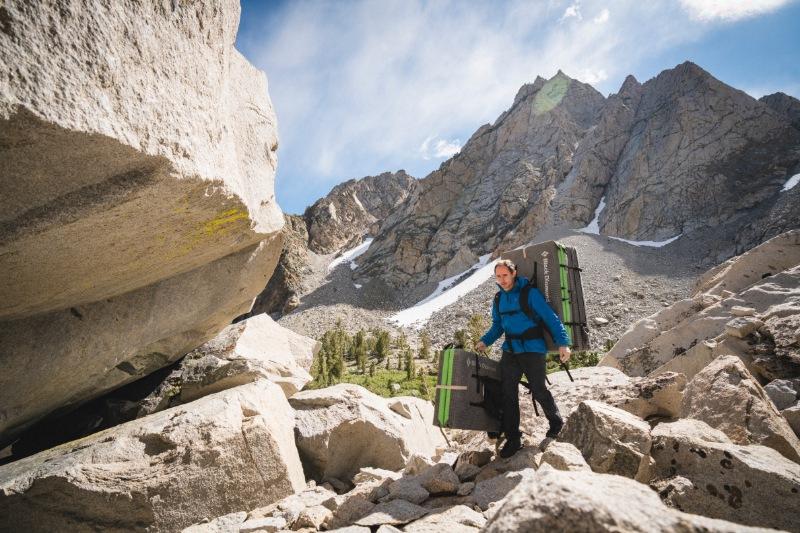
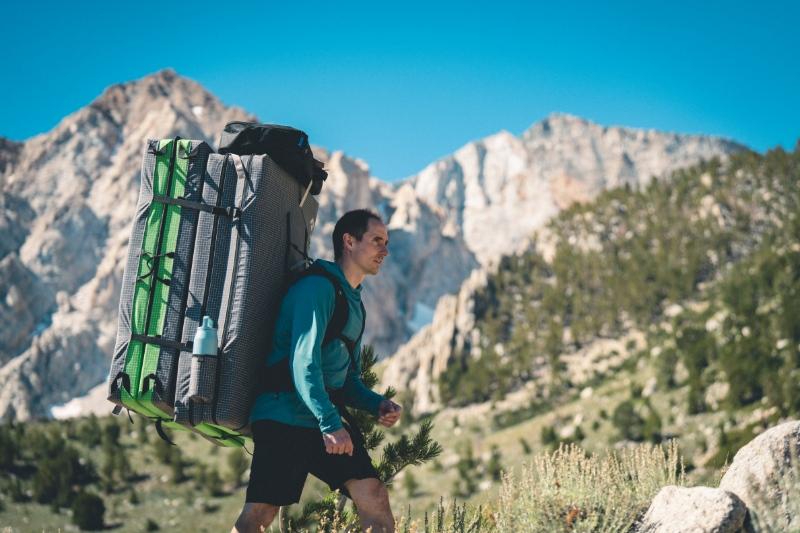
- Make sure the crash pad includes a comfortable carrying system
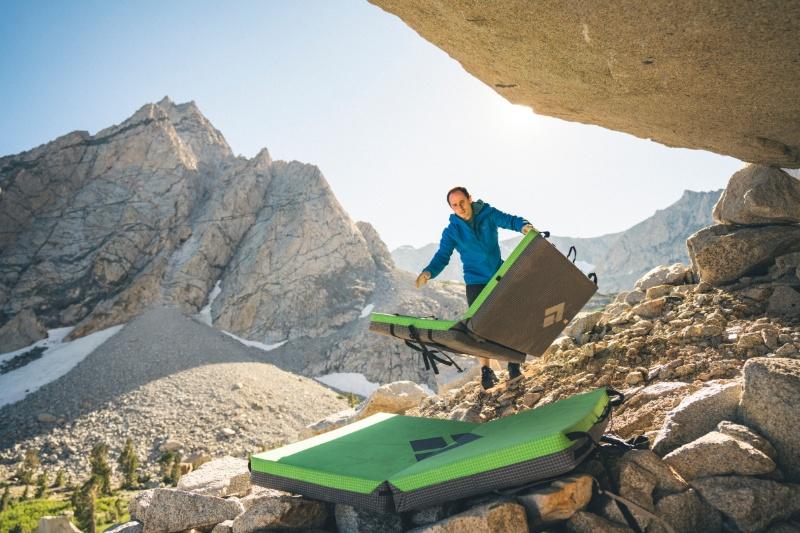
- Position the crash pad under the most exposed move and anticipate the potential fall line
- Combine several crash pads to enlarge the landing zone and better protect against side falls
- Check the ground beneath the pad: no rocks, holes or unstable slopes
Discover our climbing crash pads
Choosing the right crash pad ensures safe landings when bouldering, whether on low problems, traverses or higher blocs. To compare shapes, thicknesses and carrying systems, browse the full selection.
What is a crash pad?
Climbing crash pads are essential protective mats for outdoor bouldering, made from various materials such as high-density polyurethane foam, reinforced polyester or EVA foam. Foldable, lightweight and easy to carry, these impact-absorbing mats cushion falls and keep you safe from your very first attempts.
Why a crash pad is essential for bouldering
In bouldering, falling is part of the game. Without a protective mat, a poorly controlled landing can be costly. The crash pad reduces ground impact and lowers the risk of injury, particularly to ankles, knees and the back.
Even with spotters, the crash pad remains fundamental. It provides a clean, stable landing zone and allows you to climb with greater confidence, without overthinking the fear of falling.
How a crash pad works
An impact-absorbing crash pad is designed to dissipate the climber’s energy during a fall from a few metres. It combines multiple foam layers, often dual-density (or even tri-density), to manage impact without “bottoming out”. Typically, the top layer is firmer to absorb the initial shock, while the lower layer is softer to distribute pressure evenly. The goal is simple: absorb, stabilise, protect.
Some models are inflatable, offering effective cushioning with a much smaller packed volume than foam models. Very practical for those who want to travel light while maintaining safety.
The different types of crash pads
Taco (single-piece)
A taco crash pad is made from a single continuous foam block that folds without a hinge, eliminating gaps in the landing surface and providing better protection on uneven ground. Only fold it for transport to minimise wear along the fold line.
Hinge / bi-fold (two-panel fold)
A hinge crash pad features two panels joined by a central hinge, allowing it to fold in half for more compact transport than a single-piece taco pad.
Enhanced hinge (reinforced hinge)
Some brands improve the standard hinge design, for example with an angled, protected or reinforced hinge, to reduce the central weak point typical of hinge/bi-fold crash pads.
Hybrid (taco + hinge combination)
Hybrid crash pads combine the easy folding of a hinge model with a foam layer covering the central zone for better protection.
Tri-fold (three panels)
The tri-fold design uses three panels joined by two hinges, making the pad more compact and better balanced to carry on your back during the approach.
Multi-fold (more than three panels)
Multi-panel pads follow the same principle as tri-folds but with additional sections, resulting in an even more compact folded format for transport.
Inflatable crash pads
Inflatable crash pads replace traditional foam with an air-filled structure that can be deflated to significantly reduce packed volume.
Modular pads
Modular pads consist of separate elements that can be assembled to create a wider landing area or one adapted to the terrain.
Maxi crash pads
These offer a larger landing surface and greater cushioning. Ideal for traverses, uneven ground or higher boulders.
Bonus: the accessory mat
Some crash pads come with a small accessory mat, providing a clean spot to remove your shoes and put on your climbing slippers without getting them dirty.
How to choose your climbing crash pad
Size and landing surface
Before asking yourself what the ideal size is, it’s important to understand that a single crash pad provides a rather limited landing area, especially if the boulder problem involves moving sideways. Keep in mind that you’ll need to combine several crash pads for maximum safety. If you’d rather not buy multiple pads, consider forming a small group of climbers to share your pads and create a larger landing zone.
Thickness
Thickness typically ranges between 8 and 12 cm. A thinner crash pad is suitable for low boulders or as a secondary pad. Thicker models provide more reassurance as the height increases.
Beyond 12 cm, you’re looking at excellent cushioning — the thicker the crash pad, the more comfortable the landing. However, while the impact absorption improves, the weight also increases.
Foam density
The performance of a crash pad depends not only on its thickness but also on its density, usually expressed in kg/m³. A well-designed dual-density construction minimises the “bounce” effect and enhances stability. The denser top foam prevents harsh bottoming out, while the softer lower layer helps dissipate energy more effectively.
Carrying system
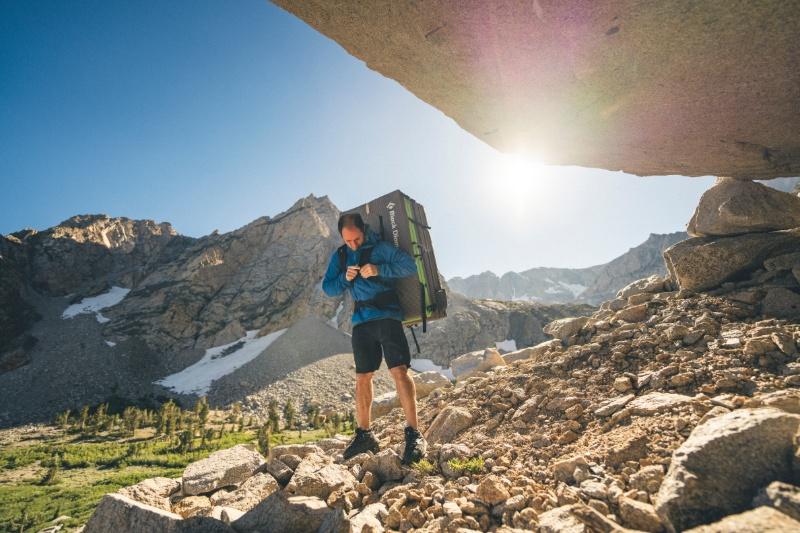
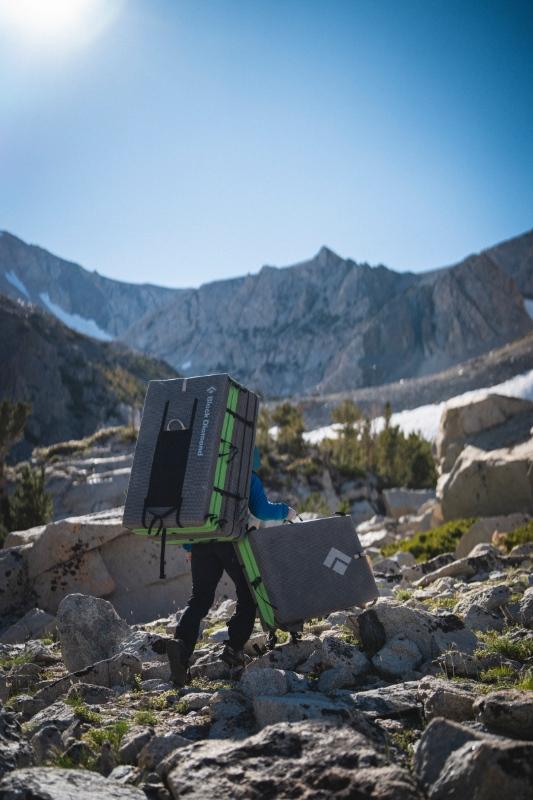
The carrying system is often underestimated. Outdoors, you’ll be walking — sometimes for quite a while. A heavy crash pad that’s uncomfortable to carry quickly becomes a burden.
Look for a model with padded shoulder straps, a hip belt and side handles. Weight generally ranges from 3 to 10 kilograms depending on the size and thickness.
Fabric durability and longevity
The outer fabric must resist abrasion. Boulder fields are rarely gentle on gear. Tough materials such as Cordura or reinforced polyester offer better long-term durability.
Also check the straps, buckles and closures. A well-designed crash pad is easy to carry and won’t open while you’re on the move.
Small details that make a big difference
Some models include useful features such as a more non-slip surface, water resistance, attachment systems for shoes or backpacks, or the ability to link multiple crash pads together.
These details may seem minor, but they can significantly improve comfort and practicality at the crag.
How to anticipate your fall
From what height can you fall safely?
The thickest bouldering pads can absorb falls from up to 4 metres, but even from two metres, injuries are possible — so crash pads should never replace careful judgement. Beyond 4 metres, the risk becomes too high, and crash pads are no longer suitable for safe climbing.
How to fall correctly
Although you won’t always have the luxury of controlling your fall, it’s worth following a few practical guidelines whenever possible, as proper landing technique helps prevent injury. In bouldering, avoid landing stiff-legged on your heels. Ideally, bend your knees to absorb the impact and, if necessary, roll backwards to dissipate energy. The crash pad cushions the impact, but good technique reduces strain on your ankles, knees and back. Be aware of the “bottoming out” effect — when the compression is so great that you feel the ground beneath the pad — a sign that the cushioning has reached its limit.
How to position your crash pad at the boulder
Placing the crash pad correctly
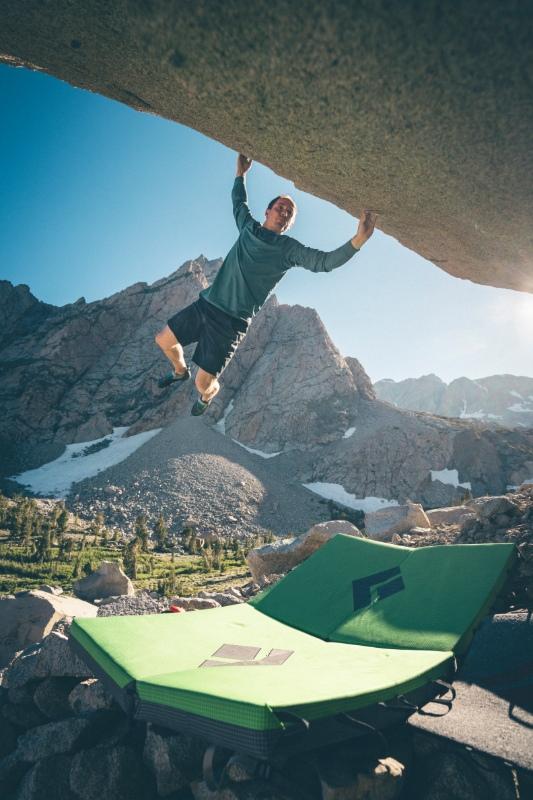
A crash pad should be placed under the most hazardous move, not simply under the climber’s current position. Anticipate the fall trajectory, especially if the problem involves lateral movement.
The goal is to secure the landing zone, not to cover a random area.
Combining multiple crash pads
Placing several crash pads side by side increases the protection area. This is often the best solution for traverses or uncertain landings.
Stacking crash pads can improve energy dissipation, but be cautious — layering pads can create instability, especially on uneven ground, which may cause imbalance upon impact.
Managing holes, rocks, slopes and cold conditions
A crash pad placed on uneven terrain can become a hazard. Always check the ground before climbing. A rock under the pad can create a hard spot, while a hole can twist an ankle.
On a slope, the pad may slide. In that case, wedge it securely or use a second pad to stabilise the setup.
Foams can stiffen in cold weather, reducing their shock absorption and altering the feel of the landing.
The role of spotters and good safety habits
Spotters aren’t there to “catch” the climber. Their role is to guide the fall and help direct the climber onto the crash pad in a safer position.
The crash pad provides the impact absorption, while the spotter helps control the landing. The two work together — they’re complementary, not interchangeable.
Which crash pad brands to choose?
Equipment from leading brands remains a reliable choice. Snap, Black Diamond and Petzl all offer high-performance crash pads designed for outdoor bouldering. The main differences lie between models rather than brands. Some stand out for their unique approach: Snap offers an inflatable crash pad (Air Shock 1) focused on compactness and light weight, while Petzl highlights single-piece pads with multi-layer foam construction and a patented folding system on certain models. In addition to producing quality gear, Black Diamond distinguishes itself with a strong commitment to sustainability, publishing an environmental impact report and promoting responsible manufacturing practices.
The right choice for a first crash pad
For beginners, a standard model with dual-density foam, book-style folding and a comfortable carrying system is an excellent option. It covers most situations and remains easy to handle.
Key points before heading out to climb
A crash pad doesn’t replace vigilance. It reduces risk but doesn’t eliminate it. The best approach is to choose a suitable pad, position it carefully, and climb with a well-managed landing zone.
In bouldering, safety often comes down to small details. The crash pad allows you to push your limits more confidently — without turning every fall into an unpleasant surprise.