


Double ropes
Take on multi-pitch routes with a double rope specially designed for climbing. Its slim diameter, generally between 7.8 and 9 mm, makes it perfect for versatile use, whether you're alpine climbing or ice climbing. Thanks to its alternate clipping system, it reduces rope drag and also lets you abseil between 50 and 60 meters. Find the double rope that fits your style, and get the best price with top brands like Petzl, Mammut, Beal or Edelrid.
Read more Show less

-
Recommended price
£145.11
-24%
From £109.91
- 50
- 60
- 70
-
Recommended price
£145.11
-24%
From £109.91
- 50
- 60
- 70
-
Recommended price
£109.91
-20%
From £87.91
- 30
- 40
- 50
- 60
-
Recommended price
£127.69
-20%
From £101.99
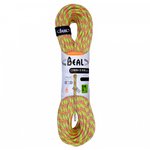
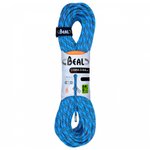
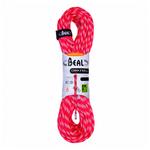
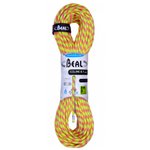
The Cobra II 8.6mm Dry Cover Anis is a lightweight, smooth, resistant and versatile dynamic rope for al mountain sports, made by Beal, the French climbing brand.
- 50
- 60
-
Recommended price
£127.69
-20%
From £101.99
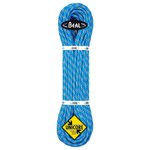
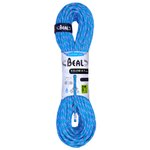
Versatile and dynamic rope offering an excellent weight/resistance ratio, the Cobra II 8.6mm Dry Cover Blue from Beal will follow you on all your mountain activities.
- 50
- 60
-
Recommended price
£149.51
-20%
From £118.80

- 70
-
Recommended price
£149.51
-20%
From £118.80
- 70

-
Recommended price
£127.69
-20%
From £101.99
- 50
- 60
-
Recommended price
£120.47
-19%
From £96.71
-
- 50
- 60
-
Recommended price
£120.47
-19%
From £96.71
-
- 50
- 60
-
Recommended price
£288.99
-11%
£255.11
- 60
-
Recommended price
£338.71
-16%
£281.51
- 60
-
Recommended price
£338.71
-16%
£281.51
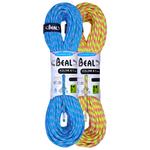
Package of 2 Beal Ice Line 8.1 mm Golden Dry ropes, alpi and glacier type, treated against dust and water.
- 60
-
Recommended price
£140.71
-20%
£112.55
- 50
INCLUDED
DAY RETURNS
Fixed costs
-
Recommended price
£140.71
-20%
£112.55
The Ice Line 8.1mm Golden Dry Emeraude from Beal is a thin rope for mountaineering and glacier terrain offering smoothness, low impact force and ruggedness. It is treated against dirt and water.
- 50
-
Recommended price
£140.71
-20%
£112.55
Beal’s Ice Line 8.1mm Golden Dry Orange thin rope is suitable for mountaineering and glacier terrain thanks to its smoothness, low impact force and ruggedness. It is treated against dirt and water.
- 50
-
Recommended price
£206.93
-19%
From £166.23
-
- 60
- 70
-
Recommended price
£255.33
-24%
£193.51
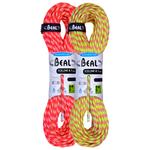
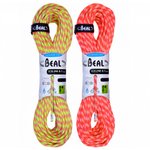
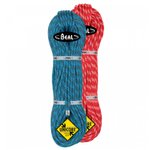
Pack of two Beal Cobra II double ropes, ideal for long routes, cliff climbing and mountaineering, with Dry Cover treatment to reduce abrasion and increase hydrophobicity!
- 50
-
Recommended price
£275.88
-24%
£207.59
-
- 80
Loading...
The different types of ropes: single, half, and twin
There are three main types of climbing ropes: single ropes, half ropes, and twin ropes.
- The single rope is generally used for sport climbing on single-pitch routes. Its diameter ranges from 9 to 11 mm and it can be up to 80m long.
- The half rope, also known as a double rope, consists of two separate strands and is commonly used in mountaineering or on multi-pitch routes. Its diameter is thinner, between 8 and 9 mm, and the length varies from 50m to 100m.
- The twin rope has an even thinner diameter, between 7 and 9 mm, and is used for ice climbing or mountaineering on challenging terrain.
These three types of ropes have specific features and uses, to be chosen according to your climbing style. There are also multi-standard ropes that meet all three requirements and can be used for different types of climbing.
Understanding the benefits of half ropes
The half rope offers many advantages for climbers. It stands out for its flexibility and light weight, making it easy to handle while climbing.
- First, its two-strand design makes gear retrieval on routes much easier, allowing for smoother progression.
- Additionally, on traverses during the climb, the half rope—where the strands are clipped alternately—greatly reduces rope drag, making the ascent easier and more comfortable.
- Finally, the strand length of 50 to 60 meters allows for quick abseils. At the anchor, simply tie the two strands together to set up the rappel and descend quickly. Plus, with two 60-meter strands you can rappel full 60-meter pitches, whereas with a 70-meter single rope, you not only have to pull half the rope through the anchor, but your usable rappel length is only 35 meters.
In the end, the half rope is a valuable tool for any climber looking for mountain gear that combines efficiency, safety, and comfort.
Half rope: the ideal choice for mountaineering
Using a half rope in mountaineering offers several significant advantages.
- Rope drag management: Thanks to its alternate clipping system, the half rope allows for better rope drag management, making the climb easier for the team.
- Strength: The half rope stands out for its high resistance. If one strand fails, the second strand ensures the climber’s safety.
- Rappelling: The half rope allows you to rappel longer distances, which can be crucial in an emergency retreat.
- Versatility: The half rope is valued for its versatility, suitable for all types of terrain, whether glacial or rocky.
- Climbing as a team of three: With a half rope, a lead climber can belay two seconds simultaneously.
These advantages make the half rope a top choice for mountaineers.
For effective use of a half rope in mountaineering, several key points need to be considered:
Strand color and patterns: Some half ropes feature strands with different colors or patterns to make identification and rope management easier during the climb.
The length of the half rope is a crucial criterion when buying. Standard lengths are 50m and 60m, but your choice will depend on several factors.
In general, a 50m rope is sufficient for most mountain routes and makes rope drag management easier. It’s also a lighter and thus more comfortable choice for long approaches and big climbs.
On the other hand, a 60m rope may be necessary for longer routes or bigger rappels. It gives you more options, but can create more rope drag, especially on rocky terrain.
Half ropes for multi-pitch climbing
Clipping with a half rope requires some know-how, especially to avoid tangling the strands.
The leader needs to remember which strand was last clipped, then clip the other strand next, avoiding crossing the ropes.
The second climber belays the leader with both strands in the belay device. This type of belaying takes a bit of practice since each strand moves independently.
Using half ropes on multi-pitch routes is highly valued for its versatility and safety. Climbers especially appreciate the ability to reduce rope drag by alternately clipping each strand into quickdraws. In addition, half ropes offer increased safety: if one strand fails, the other takes over. Rappelling is also much more efficient. In the mountains, a quick retreat is sometimes necessary and directly contributes to safety.
All about half ropes from different brands
The Beal Legend 8.3mm and Beal Ice Line 8.1mm are two highly regarded half rope models for their lightness and durability.
- The Legend 8.3mm stands out with an impact force of 5.3 kN and a sheath that makes up 39% of the rope. It's ideal for big routes and adventure terrain thanks to its great handling.
- The Ice Line 8.1mm is a half rope that reduces water shrinkage by over 50%. It performs well with an impact force of 4.90 kN.
The Beal Cobra II 8.6mm is another option, known for its versatility. It's light and smooth, making it comfortable for big routes, crag climbing, and mountaineering.
Choosing an Edelrid half rope means opting for German quality and innovation.
Edelrid offers a range of half ropes suited to different climbing styles. Its flagship model, the Perfect Alpine II, is especially appreciated for its high quality, great handling thanks to the Thermo Shield treatment, and its versatility in mountaineering and climbing.
For those seeking the lightest option, the SKIMMER ECO DRY 7.1MM is the thinnest and lightest on the market. Perfect for situations where every gram counts, it offers excellent grip and smooth handling, ideal for ice and mixed climbing.
On the other hand, the STARLING PRO DRY 8.2MM from the “Pro Line” range stands out for its robustness and can be used as a half or twin rope. It features the Thermo Shield finish for perfect rope suppleness, and the Pro Dry finish for increased resistance.
Finally, Edelrid is also recognized for its eco-friendly approach, offering bluesign® certified products.
Petzl is a brand renowned for the quality of its climbing and mountaineering gear, including half ropes. The Rumba and Tango models are especially popular for their versatility and durability.
- Rumba: With its 8mm diameter, the Rumba offers an excellent balance between stiffness and flexibility, allowing for smooth handling. It features a Dry treatment to prevent slipping in the belay device.
- Tango: With a slightly larger diameter (8.5mm), the Tango is known for its longevity. Its UltraSonic Finish bonds the core and sheath at the ends, increasing durability.
Mammut half ropes come in two main categories: low-diameter ropes like the 7.5 Alpine Sender or 8.0 Alpine Dry, and multi-standard ropes like the 8.7 Alpine Dry. The former are only for use as half ropes on rock or ice and offer impressive lightness, while the latter are true Swiss Army knives—slightly heavier but usable as single, half, or twin ropes.
The importance of half rope diameter
The diameter of a half rope plays a crucial role in its performance and safety. Generally, the diameter ranges from 7.7 to 8.5 mm. A thinner rope is lighter and more manageable, ideal for disciplines requiring smooth, fast movement. Conversely, a thicker half rope offers better resistance and durability, preferable for beginners or those prioritizing safety. However, a thin half rope requires a high level of expertise for safe use.
In short, the choice of diameter depends on several factors, such as:
- The climber’s skill level
- The type of climbing (mountaineering, multi-pitch, etc.)
- Whether you prioritize lightness or durability
Feel free to contact us if you’re unsure about which diameter to choose for your half rope.
Buying a 100m half rope: when and why?
Buying a 100m half rope can be a smart choice for certain specific situations. This length is ideal for big routes where you want to climb or rappel 50m without having to switch ropes. Plus, a 100m rope can be cut into two 50m strands, giving you more flexibility for tying in and transport.
However, it’s important to consider the challenges of such a length. A 100m rope can be harder to handle, more prone to twisting, and heavier to carry.
Before purchasing a 100m half rope, make sure to assess your needs in terms of:
- Route type: big routes, alpine routes, etc.
- Tying-in techniques: make sure you’re comfortable tying in with a half rope.
- Transport: consider how easy it is to carry and manage the rope on your outings.
Using a half rope for abseiling
For optimal use of a half rope when abseiling, several techniques are essential. First, setting up the rope at the anchor. Make sure the anchor is solid and the knot joining the two strands (overhand knot) is tight. A stopper knot at the end of the rope is recommended to prevent accidents.
Next, just like with a single rope, it’s important to set up a prussik backup on the rope. This secures your descent by automatically locking the rope if you let go.
Remember the color or pattern of the free strand. At the anchor, the joining knot only allows the rope to slide in one direction. So, to pull the rope afterwards, it’s important to know which strand to pull. A handy tip is to clip the free strand with a quickdraw or a personal anchor. That way, when you reach the next anchor below, the first person down can already prepare the correct strand in the anchor.
When using a half rope for abseiling, it’s vital to follow certain guidelines to ensure your safety.
- Always check your gear before use. A worn or damaged rope can be a real hazard.
- Don’t forget to check your knots are tight before starting your descent.
- Always use a backup system in case of a fall, such as a prussik knot.
- Familiarize yourself with abseiling techniques before tackling a big route. This includes clipping, unclipping, rappelling, and rope retrieval.
- Finally, it’s recommended to always carry a spare cord. It can be used for many things if needed, such as replacing a worn anchor sling.