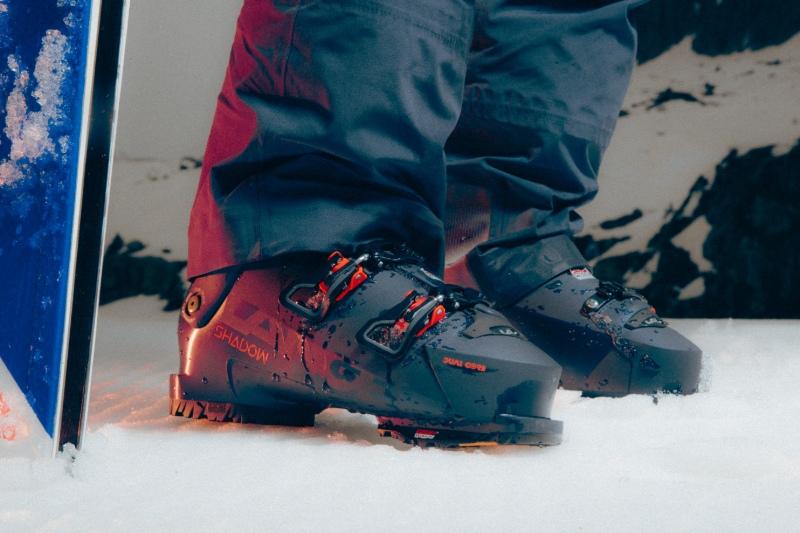
The ski boot. For many, it conjures memories of Sunday evening agony, aching feet after a full day on the slopes. But that reputation is largely undeserved. Modern ski boots have become comfortable, highly technical, and extremely customisable. More importantly, they are the single most critical element of your skiing setup.
They are literally the interface between your body and your skis. Power transmission, edge control, thermal insulation, everything depends on them. Choose the wrong boots and you’ll struggle all season, no matter how good your skis are.
In this comprehensive guide, Glisshop experts explain how to navigate the various technical criteria (flex, last width, sole, liner) to find the boot that perfectly matches your foot shape, skill level, and skiing style.

What size ski boot should you choose?
Mondopoint vs European sizing: understanding the system
Ski boots don’t use your regular shoe size. They are measured in Mondopoint, an international unit that simply corresponds to the length of your foot in centimetres. A 27 cm foot equals a Mondopoint size 27, which is roughly a European size 42 or 8 is UK sizes.
Find a full tutorial here: How to find your alpine ski boot size
How to measure your foot accurately
Measure your foot at the end of the day, standing up, wearing your ski socks. Feet are slightly longer in the evening than in the morning. Place your foot flat on a sheet of paper, draw a line behind your heel and in front of your longest toe, then measure the distance. This measurement in millimetres is your starting point.
To make things easier, Glisshop provides a printable and foldable foot measuring chart that lets you measure both the length and width of your foot at home. [Download the Glisshop foot measuring tool]
How to properly try on a ski boot: the flex position test
When standing upright in an unbuckled boot, your toes should lightly touch the front. That’s normal and intentional. Then move into a flexed position (knees bent as if skiing, shins pressing against the tongue). Your foot will move back, your heel will settle into the rear of the shell, and your toes should no longer touch. If you feel no pressure points in this stance, the size is correct.
’The inner liner will mould to your foot over time, and the foam will gradually compress. Don’t worry if the boot feels slightly tight at first, that’s exactly what you want.’ Glisshop expert advisor
For more detail, Renaud, alpine ski expert, explains everything in his tutorial with a video by Martin: How to properly try on a ski boot
Which last width should you choose based on your foot shape?
The last width (expressed in millimetres, also called ‘fit’ or ‘boot width’) refers to the internal shell width at the metatarsal area, the widest part of your forefoot. It’s often overlooked but absolutely crucial: a boot that’s the right length but too narrow or too wide will cause constant discomfort.
Narrow feet: last < 100 mm
If you have narrow feet, go for a last under 100 mm (98–100 mm). This snug fit ensures maximum support and prevents foot movement inside the shell, which is key for precise control.
Medium feet: last 100–102 mm
The majority of skiers fall into this category. A 100–102 mm last offers a great balance between comfort and performance, ideal for intermediate to expert skiers.
Wide feet: last 102–106 mm
If you naturally have wide feet or suffer from bunions (hallux valgus), look for a last between 102 and 106 mm.
How to measure your foot width
Place your foot on the measuring chart and measure the width across the ball of the foot (metatarsal area). Compare this measurement with the boot last specified by the manufacturer. If unsure, Glisshop’s experts can help you.

High instep alert: a commonly overlooked factor
The last width measures the width of your foot, and the size covers the length, but neither indicates the height across the instep. Skiers with a high instep often experience pain on the top of the foot due to shell pressure in that area. It’s one of the most frequent, and least recognised, sources of boot discomfort.
Some brands are known for offering shells with greater vertical volume around the instep. Atomic, for instance, with its Hawx range, provides more space in this area, making it particularly suitable for high instep feet. If this sounds like you, don’t hesitate to contact one of our experts or visit our shop. Our ski technicians and bootfitters will be happy to help you find the perfect fit!
Flex rating: which stiffness level suits your skills?
The flex is the stiffness rating of the shell when flexing forward. The higher it is, the stiffer, more responsive, and more demanding the boot will be. The lower it is, the softer, more forgiving, and more comfortable it becomes. Choosing the right flex means selecting a boot that works with you, not against you.
Beginners and intermediates: flex 50 to 80
A soft boot forgives posture mistakes and absorbs snow irregularities. Ideal for those starting out or skiing only a few days a year.
- Flex 50–70: perfect for beginners, very comfortable
- Flex 70–80: good progression, ideal for intermediate skiers
Advanced skiers: flex 80 to 110
Skiers who control their edges and seek precision without sacrificing comfort will find their sweet spot in this range. It’s the broadest and most commonly used category.
Experts: flex 110 and above
Meant only for skilled skiers who ski aggressively and want immediate power transmission. A flex that’s too stiff for your level will quickly tire you out.
The influence of body type and weight
Flex isn’t only about skill level. Your weight plays a key role: a heavier skier should choose the higher end of their level’s flex range, while a lighter skier should stay towards the lower end to avoid fighting against their boots.
Women’s flex: a slightly lower range
The flex range of women’s ski boots is generally shifted lower than men’s models, simply because women on average have a lighter build. A boot that’s too stiff for your weight can’t be properly exploited, making it imprecise and tiring.
- Beginner / modest level: flex 50 to 70, soft and comfortable, very forgiving
- Intermediate: flex 70 to 90, good balance between performance and comfort
- Advanced / expert: flex 100 and above, maximum responsiveness and precision
The liner: the heart of the ski boot
The inner liner directly wraps around your foot. It plays a decisive role in comfort, warmth, and precision. Often overlooked, it’s what makes the difference between a boot you wear all day without thinking about it and one you can’t wait to take off.
Traditional foam vs heat-mouldable liner
Traditional foam liners soften and gradually adapt to the shape of your foot over time. They’re perfectly suitable for recreational skiers.
Heat-mouldable liners go a step further: after being heated for a few minutes in a specialist oven in-store, they perfectly conform to your foot shape in minutes. The result? A boot that feels custom-fitted from the very first run.
Foam density: comfort vs precision
- Soft foam: more cushioned, ideal for sensitive feet and long sessions
- Dense foam: more direct power transfer, favoured by skilled skiers
Buckles: from 2 to 5
The buckle system allows you to adjust the shell around your foot. The more buckles there are, the finer and more precise the adjustment. Most ski boots feature four buckles, the most common and versatile configuration.
Plastic vs aluminium buckles
Plastic buckles are lighter and sufficient for recreational use. Aluminium buckles are more durable, offer finer adjustment, and are preferred by demanding skiers.
BOA systems: advantages
Some models integrate BOA systems (dial and cable) instead of some or all buckles. You’ll find hybrid models combining a BOA wheel with buckles, or boots featuring a dual BOA closure system.
Advantages: progressive tightening, micro-adjustable, quick, and easy to operate with gloves on.
Strap and power strap: function and adjustment
Often overlooked, the strap (or power strap) is crucial. It’s the Velcro strap at the top of the cuff that secures the boot around the shin. It ensures overall support and completes the shell closure. Without it properly tightened, even a perfectly fitted boot will lose precision.
’The strap is the last thing you tighten and the first you undo. Many skiers forget it or leave it too loose, a mistake that costs performance.’ Glisshop expert tip

Sole standards: compatibility with your bindings
The sole of your boot must be compatible with your bindings. This is not a minor detail: incompatibility can cause unintentional release during a fall, or conversely prevent the binding from releasing, which may result in injury.
To learn more, check out our dedicated tutorial: Everything you need to know about ski boot and binding compatibility.

Choosing according to your discipline
Alpine ski boots: versatility and precision
The vast majority of skiers will be golden with a standard alpine ski boot. Choose a flex suited to your skill level, a boot volume matching your foot shape, and a Grip Walk sole for walking comfort.
Freeride / off-piste ski boots
Freeride skiing requires a boot that absorbs impacts from variable snow while providing enough support to control wide skis. Look for a slightly softer flex than for pure piste skiing, with a comfortable fit and good thermal insulation.
Women’s ski boots: adapted anatomy and fit
Women’s boots aren’t just men’s models in different colours. They feature anatomical adjustments: a shorter cuff to suit lower calf positioning, a narrower shell, and often a slightly roomier fit to match the female foot shape.
Children’s ski boots: specific criteria
For kids, prioritise comfort and ease of entry over pure performance. Simple closure systems (few buckles, very soft flex) help children gain independence on the slopes.
Ski Boot Care and Maintenance
Drying: Best Practices
After each day on the slopes, remove the liners from the shells and allow them to dry separately at room temperature. Never place your boots near a radiator or any direct heat source: excessive heat damages the plastics and deteriorates the liner foams. Electric boot dryers with gentle forced air are the ideal solution.
Off-Season Storage
- Store your boots with the buckles fastened to help them retain their shape
- Remove the liners if the boots are kept in a damp environment
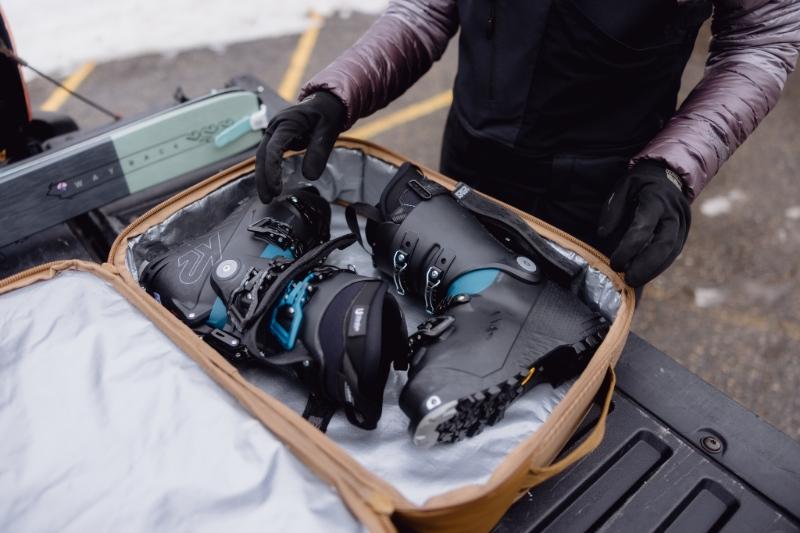
- Protect them in a boot bag or cover to keep out dust and moisture
- Avoid uninsulated garages where freezing temperatures can damage the plastics
Lifespan of a Ski Boot
The lifespan of a ski boot depends on the shell material, storage conditions, and how intensively it’s used. A tell-tale sign that it’s time to replace them: a shell that becomes brittle or deforms excessively when flexed.
A Look at Bootfitting: When Customisation Changes Everything
Bootfitting is the art and science of customising a ski boot to perfectly match your foot anatomy. Even the best boot on paper can reveal issues once worn: pressure points on the instep, pinched toes, or a cuff that’s too tight around the calf... Bootfitting solves all of these problems.
What Proper Bootfitting Involves
- Analysis of foot morphology (arch height, width, volume, irregularities)
- Custom heat-moulding of the liner
- Grinding or local shell expansion in pressure areas
- Addition of custom footbeds or alignment shims
- Adjustment of cuff inclination (forward lean) and alignment
Who Should Consider Bootfitting?
In theory, everyone can benefit from it. But it’s particularly recommended for:
- People with atypical feet (very wide, very narrow, high arches, flat feet)
- Expert skiers seeking to optimise performance
- Those recovering from a foot or ankle injury
- Anyone who has suffered discomfort with previous ski boots
Heat Moulding: When to Do It and How It Works
Heat moulding involves warming the liner to a precise temperature (usually between 65°C and 80°C depending on the brand), then putting on the boot and standing in a skiing stance for a few minutes while the foam cools and sets to the shape of your foot.
Our in-store technicians are trained in bootfitting and equipped with the necessary tools: heat-moulding ovens, grinding and stretching equipment, and a full range of customisable insoles. Don’t hesitate to contact us before your next purchase.
Tip: if you choose a heat-mouldable liner, opt for high-density foams that require higher moulding temperatures. They’ll better resist deformation once in skiing position.

FAQ: Your Most Common Questions About Ski Boots
Can You Ski with Boots That Are Too Big?
No, and it’s dangerous. Oversized boots allow your foot to move inside the shell, leading to significant loss of precision and potential falls. Not to mention the blisters caused by repeated friction.
Should You Buy Ski Boots In-Store or Online?
Ideally, your first pair should be purchased in-store, as fitting is essential. For replacing a model you already know, buying online is perfectly fine. Glisshop offers an easy return service if the size isn’t right.
When Should You Heat-Mould Your Liners?
Ideally right after purchase, if your liners are heat-mouldable. This prevents discomfort during your first outings while the foam naturally adapts. Repeat the process if your foot shape has changed or if the liner has deformed too much.
|
Find Your Ski Boots at Glisshop |
|
|
The full range, all levels and disciplines |
|
|
From flex 50 to flex 130+, all fit volumes |
|
|
Shells designed for female anatomy |
|
|
Comfort, easy entry, and progressive flex |
|