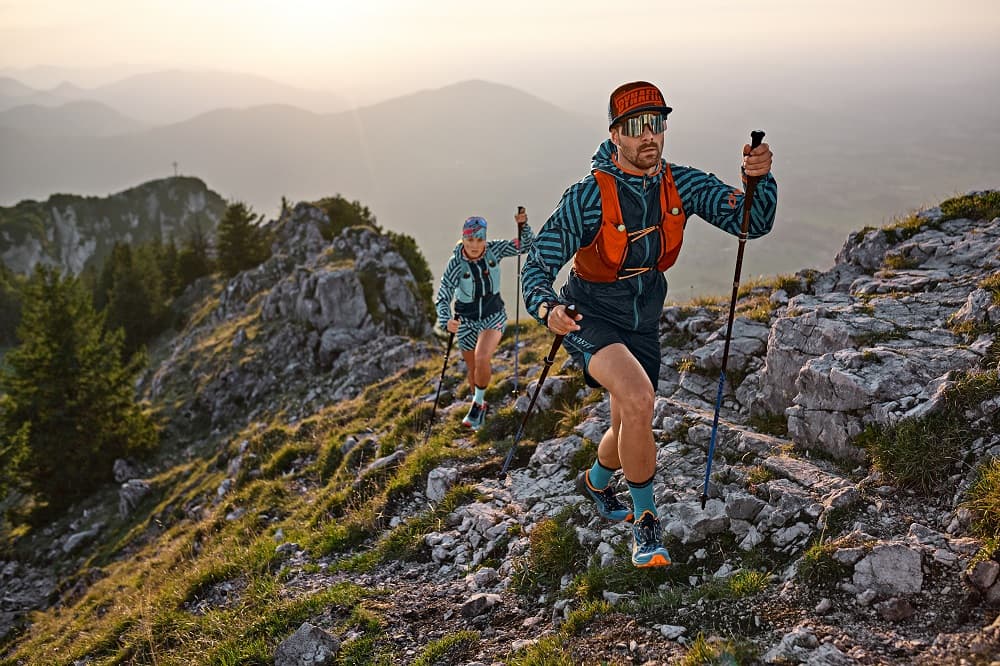
Just as essential as vests and shoes, trail running poles should not be selected based solely on their weight. Compactness, speed of deployment, stiffness, grip comfort, and ease of carrying all have a direct impact on performance during a race. It’s also crucial to know when to use them, how to push efficiently, and how to stow them away without losing time. This guide will help you choose the right trail poles and master their use out on the trails.

Key Points to Keep in Mind
- Trail running poles are not essential, but they are extremely useful.
- Choose between telescopic, folding or single-piece poles depending on your running style and need for convenience.
- Telescopic poles offer versatility for both summer and winter use.
- Folding poles prioritise compactness, low weight and suitability for long-distance running.
- Fixed-length poles are rarely used for trail running.
- Weight and material determine performance, comfort and durability.
- Carbon is ultra-light and provides excellent vibration damping.
- Aluminium is slightly heavier but extremely robust.
- Standard straps are ideal for beginners, while glove-style straps suit technical and performance-oriented use.
- Pole length: your height (cm) × 0.68, slightly shorter for beginners.
The benefits of using poles in trail running
Trail running poles are primarily used to relieve the legs on steep ascents, improve balance on technical terrain, and distribute stress more evenly between the upper and lower body. They provide additional support on screes, uneven trails, and very steep sections. Their usefulness therefore varies depending on the terrain. On smooth or gently undulating routes, they are often less essential.
Telescopic poles are the most versatile type available. Made up of two or three sections, they collapse on themselves, allowing the length to be easily adjusted. Moreover, with plastic clips, the locking mechanism is highly intuitive and simple to operate. Once collapsed, they pack away effortlessly into a hydration vest. These poles offer excellent vibration damping, ensuring impressive durability. All these features make them a reliable companion for trail runners who are not chasing the clock but want poles that can accompany them on all their summer and winter adventures, whether snowshoeing or ski touring.
Choosing Trail Running Poles
To pick the right trail running poles, you first need to consider your style of running. A runner aiming for maximum efficiency on a vertical kilometre doesn’t have the same requirements as an ultra-trail athlete who must manage carrying capacity, fatigue, and changes in pace over many hours. The ideal choice depends on the terrain, race format, how often the poles will be used, and the balance you’re looking for between packability, durability, stiffness, and lightness.
Folding, telescopic or fixed-length poles?
Folding poles
Folding poles are the most common choice in trail running. Their main advantage is that they deploy extremely quickly. Their compact design makes them easy to carry on a running vest or in a quiver. They are particularly suitable for long-distance and ultra-trail events, where runners alternate between running sections and steep climbs where poles become essential.
Telescopic poles
Telescopic poles allow you to adjust the length, offering excellent versatility. On the downside, they are usually less compact when collapsed and slower to deploy than folding models. They are best suited to those looking for poles that can also be used for other outdoor activities beyond trail running.
Single-piece poles
Single-piece or fixed-length poles prioritise simplicity, stiffness and efficiency. They are ideal for short, intense runs, especially when kept in hand throughout the race. However, as soon as you need to stow them away, the lack of a folding mechanism becomes a drawback.
Key factors to consider:
Weight
A lightweight pole reduces swing inertia with every stride and is less noticeable over time. This is an important factor, but it shouldn’t come at the expense of durability, especially on rough terrain or when applying strong pressure on the poles.
Packability
In trail running, poles should be easy to stow and remain stable once carried. The more compact they are when folded, the easier they are to secure on the back of a running vest or belt without hindering your stride.
Stiffness
A stiff pole provides better power transfer and allows for a more direct push-off. This is particularly appreciated by runners who rely heavily on their poles on long climbs.
Materials: carbon or aluminium?
Carbon helps reduce weight and delivers a more responsive feel. Aluminium is generally a bit heavier but handles impacts and repeated stress better. The right choice depends on the balance you’re seeking between lightness, performance and durability.
Grip
The grip must ensure a secure hold even when your hands are sweaty. Its shape, diameter and material affect comfort, precision of pole placement and ease of changing hand position while running.
Strap
The strap improves pole control and contributes to efficient power transfer. A simple strap design offers greater freedom of movement, while a more supportive system allows for firmer pushing, provided it’s properly adjusted and suits your running technique.
Pole length in trail running
To determine the correct length, a simple guideline is to place the pole vertically on the ground and check that your elbow forms an angle close to 90°. This provides a reliable baseline for general use. Some trail runners then fine-tune the length according to their style. A slightly shorter model can promote a quicker motion on ascents, while a slightly longer one can offer greater support on steep gradients.
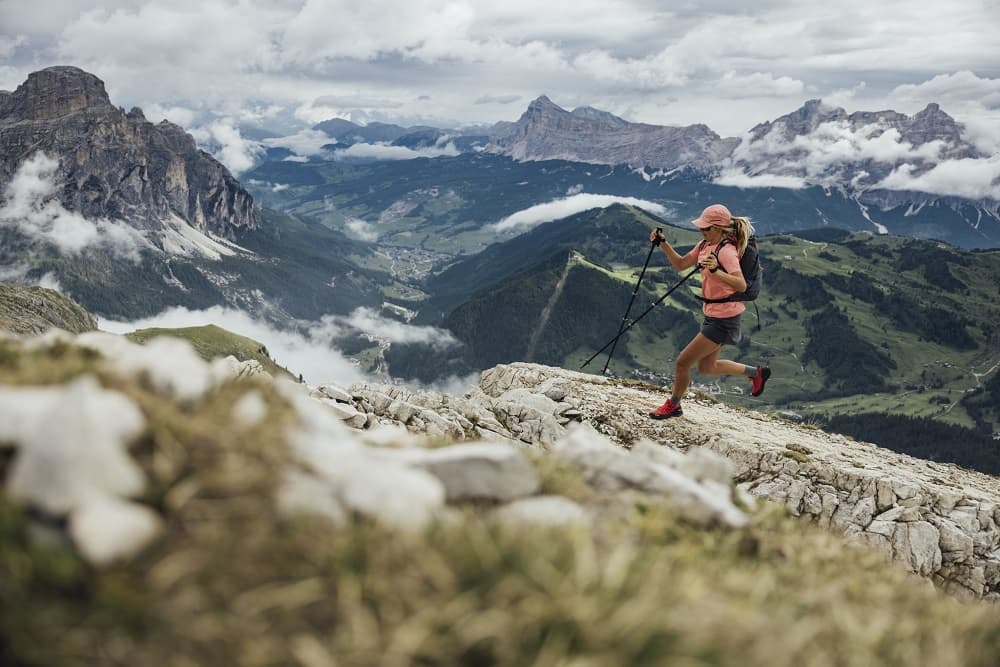
How to use your trail running poles
When should you take out your poles?
Poles are particularly useful on long climbs and technical sections where using your arms helps to relieve the quadriceps and calves. On flat terrain, during accelerations or on fast descents, they can be less beneficial and may hinder your running flow.
Holding your poles correctly
Your grip should remain relaxed, without tension. You need to apply effective pressure while keeping enough looseness to maintain fluid movement. A properly adjusted strap helps stabilise the hand and reduces energy loss.
Pushing efficiently uphill
On ascents, the poles should support your progression without breaking your rhythm. The aim is not to pull solely with your arms, but to use the poles to complement the work of your legs. Your pole plants should stay rhythmic, precise, and synchronised with the terrain. The steeper the slope, the more important their role becomes.
Stowing your poles quickly
To be truly effective, poles must be easy to fold and store swiftly. The chosen carrying system should be quick to access, without complicated handling. In long-distance and ultra-trail events, this ease of transition is almost as crucial as the pole’s performance once deployed.
Common mistakes to avoid
Using poles too systematically on rolling terrain unnecessarily tires the upper body. Incorrectly adjusted or overly long poles disrupt your technique. A tense grip reduces comfort. Finally, waiting until race day to learn how to use them is a common mistake, as proper technique and coordination should be developed during training.
Which poles should you choose according to your trail running discipline?
Which poles for a vertical kilometre?
For a vertical kilometre, the priority is usually on poles that are lightweight, stiff, and deliver immediate power transfer. As carrying them is minimal, efficiency takes precedence over versatility.
Which poles for long-distance trail running?
On long-distance trails, it’s essential to strike a balance between weight, stability, packability, and ease of handling. Foldable poles are often the most convenient and well-rounded choice.
Which poles for an ultra-event?
In ultra-trail running, ease of storage, quick deployment, and fatigue management are key factors. The most suitable option is a compact, lightweight pole that feels comfortable in hand and, of course, remains reliable throughout.
FAQ about trail running poles
Should you use poles on every trail run?
No. Their usefulness depends on the route profile, elevation gain and your running style. The steeper and more technical the terrain, the more beneficial they can be.
Are poles helpful on descents?
Their advantage on descents is generally limited. They can occasionally help to stabilise your footing on uneven ground, but they should not hinder terrain reading or the fluidity of your movement.
Is it better to choose folding or single-piece poles?
Folding poles are usually better suited to long-distance and ultra-trail running, as they are easier to stow away. Fixed-length models are ideal for specific use, such as short efforts with minimal carrying.
How should you carry your trail running poles?
Your carrying system should allow you to store and retrieve the poles quickly, without disrupting your stride or unbalancing your running vest. The best option depends on your gear setup and how often you transition during the race.