
A low drop is more natural
Not necessarily. It can provide greater ground feel, but “natural” does not mean “suitable for everyone”.
CONTACT US 020 3129 3301
Our experts are here for you
Our passionate staff is with you through every step of your purchase and helps you choose the right gear that best suits your needs.


With our Help Center
CONTACTThe drop is the height difference between the heel and the forefoot of the shoe. Everyone talks about it, but few runners really know how to choose it properly. This guide clarifies what the drop actually affects, what it doesn’t indicate, and how to transition from one value to another without overstraining your calves.
The drop of a trail running shoe corresponds to the height difference between the heel and the forefoot. It can influence some running sensations and alter how the load is distributed between the foot, calf, Achilles tendon, or knee.
However, drop alone doesn’t determine whether a shoe is “better”, more efficient, or suited to a specific runner level.
The right choice mainly depends on your running habits, footwear history, terrain, desired comfort, and your ability to adapt progressively to change.
A low drop is not exclusively for advanced runners. A high drop is not just for beginners.
Drop is a useful indicator, not a performance ranking.
Drop should always be considered alongside stack height, rocker profile, cushioning, fit, terrain, and the runner’s habits.
The best choice isn’t necessarily the most minimalist or the most “technical”, but the one your body can handle comfortably and sustainably for your actual running conditions.
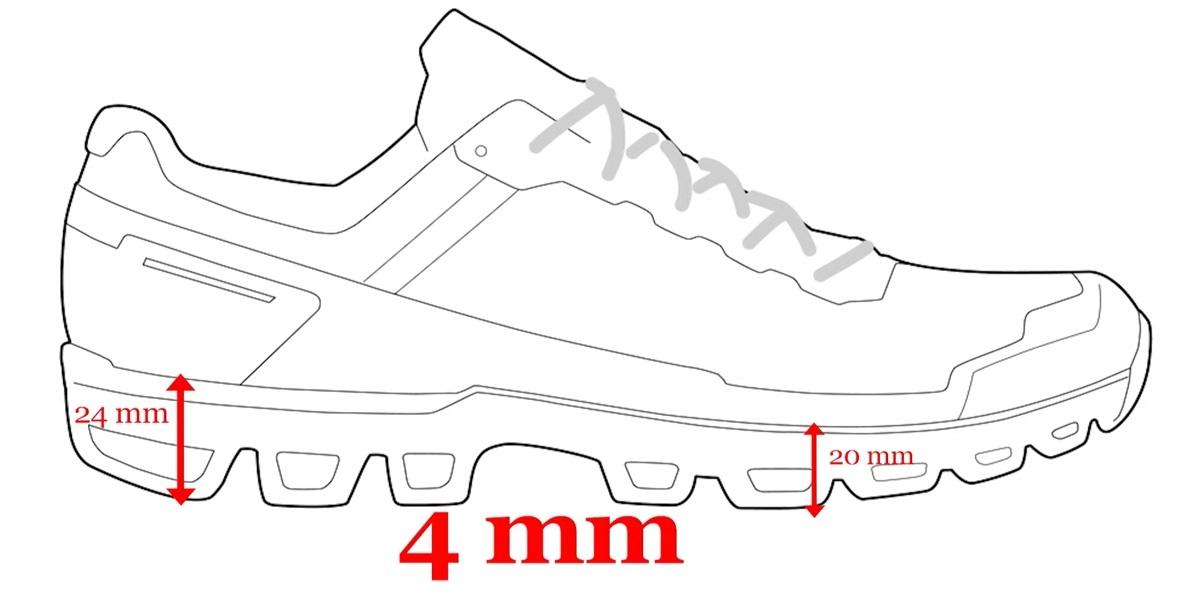
The drop is the difference in height between the heel and the forefoot of the shoe. A shoe with 24 mm under the heel and 20 mm under the forefoot has a 4 mm drop.
| Heel height | Forefoot height | Resulting drop |
|---|---|---|
| 30 mm | 22 mm | 8 mm |
| 28 mm | 28 mm | 0 mm |
| 35 mm | 29 mm | 6 mm |
The drop should not be confused with the stack height. The stack refers to the total sole thickness underfoot, while the drop only measures the difference between the heel and the forefoot.
| Concept | Definition | Why it matters |
|---|---|---|
| Drop | Difference in height between heel and forefoot | Alters certain sensations and mechanical stresses |
| Stack | Total sole thickness | Affects cushioning, protection and stability |
| Rocker | Forward curvature of the sole | Can ease the transition through the stride |
The drop value alone does not describe how a shoe feels underfoot.
Two models with a 6 mm drop can feel completely different depending on:
A highly cushioned shoe with a low drop may, for example, feel more protective than a firmer model with a higher drop.
The drop should therefore be interpreted within the overall construction of the shoe, not in isolation.
The effects vary greatly depending on terrain, pace, fatigue, body morphology, running habits and the overall shoe design.
Available studies show possible biomechanical effects, but no universal rule. The drop should be viewed as an adaptation parameter, not as a medical prescription.
There is a relationship between drop and running gait, but it is often oversimplified.
Three main gait patterns are generally identified:
A higher drop may feel more natural to runners accustomed to a pronounced heel strike. Conversely, a lower drop can enhance forefoot loading sensations and increase calf and Achilles tendon engagement.
However, these relationships are not absolute:
The most practical approach is to choose a drop consistent with your running habits and footwear history, rather than trying to “correct” your gait solely through the shoe.
| Drop | Possible sensations | Typical runner profiles | Points to watch |
|---|---|---|---|
| 0–4 mm | More direct ground feel and greater engagement of the foot and calf muscles | Runners already accustomed to low-drop or minimalist shoes | Demanding transition – monitor calves, feet and Achilles tendon |
| 5–8 mm | Versatile all-round compromise | Wide range of runners and distances | Does not guarantee comfort – stack height and fit remain decisive |
| 9–12 mm | More pronounced heel-to-toe transition | Runners used to higher drops, long-distance runners, those seeking familiar sensations | Not exclusively for beginners – do not mistake high drop with high cushioning |
The most reliable criterion is not your running level but what your body is already accustomed to. A runner who has been using shoes with an 8–10 mm drop for years should avoid switching abruptly to 0 or 4 mm before an important race.
| Situation | Cautious choice | Mistake to avoid |
|---|---|---|
| You’ve been running in 10–12 mm shoes for a long time | Try 8 mm before going lower | Switching straight to 0–4 mm |
| You already use 6–8 mm without discomfort | Stay close to that range | Changing just for fashion’s sake |
| You’re preparing for an ultra-distance race | Prioritise comfort, fit and stability | Changing drop late in your training block |
| You’ve experienced Achilles tendon pain | Seek professional advice if the pain persists | Trying a low drop without a gradual transition |
In trail running, gradients, uneven footing, descents and fatigue constantly alter your stride pattern.
The same runner may adopt very different foot strikes depending on:
This is why drop doesn’t always have the same influence as in road running. In the mountains, stability, support, protection and forefoot space can sometimes matter more than the drop figure alone.
Changing drop means altering part of the mechanical load on your body. The simple rule: the greater the difference from your previous shoe, the more gradual the transition should be.
Muscles, tendons and supporting tissues need time to adapt to significant changes in mechanical stress.
| Step | Objective | Practical example |
|---|---|---|
| 1 | Test outside of key training objectives | Easy 20–30 min run |
| 2 | Alternate with your old pair | One run out of three with the new shoes |
| 3 | Increase gradually | Add time if no unusual discomfort occurs |
| 4 | Validate on real terrain | Include climbs, descents and technical ground |
| 5 | Don’t push through persistent pain | Temporarily return to your previous pair |
Switching to a low drop to “improve your stride”. A shoe doesn’t automatically correct your running technique. It can alter sensations, but adaptation depends on the runner.
Drop has become a major marketing argument in both road running and trail running.
However, some claims are difficult to prove scientifically:
In practice, comfort and gradual adaptation often matter far more than the drop number itself.
Not necessarily. It can provide greater ground feel, but “natural” does not mean “suitable for everyone”.
False. Some experienced runners prefer a higher drop for comfort or simply out of habit.
Not guaranteed. Performance mainly depends on training, terrain, running efficiency, grip, and fatigue management.
Too simplistic. Stride pattern also varies with speed, gradient, fatigue, and running technique.
| Term | Short definition |
|---|---|
| Drop | Height difference between the heel and the forefoot. |
| Stack | Total sole thickness between the foot and the ground. |
| Rocker | Curved sole profile that promotes a smoother heel-to-toe transition. |
| Transition | Adaptation period between two different types of footwear. |
There is no universally ideal drop. The right choice depends mainly on your running habits, terrain, comfort, and footwear history. A runner used to 8 mm for several years has little reason to suddenly switch to 0 mm, even with experience.
Don’t decide based solely on your level. If you’re coming from road running with shoes around 8 to 10 mm, staying close to that range is often the safest starting point.
Not automatically. A lower drop can enhance ground feel and stability on technical terrain, but it also places more strain on the calves and Achilles tendon. In trail running, the best option depends primarily on comfort and your running habits.
It can increase certain stresses, particularly on the calves and Achilles tendon, especially if the transition is too abrupt. However, injury risk also depends on training load, terrain, and individual history.
Yes, if you’re accustomed to it. It’s a bad idea if the shoe is new or if the change is recent.
No. Drop can influence running feel, but it doesn’t automatically correct your stride. Technique should be developed progressively, ideally with professional guidance if necessary.
Current research shows that drop can alter certain biomechanical loads, particularly on the calf muscles, Achilles tendon, and foot. However, there is no evidence that a low or high drop is inherently superior overall.
Comfort, footwear history, training volume, terrain, and gradual adaptation are often more important factors than the drop value alone.
This explains why two runners of similar ability may prefer very different drops without either choice being “wrong”.
Drop influences running sensations and the distribution of mechanical stresses, but it doesn’t solely define a shoe’s performance or behaviour.
Comfort, terrain, stack height, stability, fit, and the runner’s habits often play a greater role in the final choice.
The best drop is not necessarily the one marketed as the most “natural” or “technical”, but the one that aligns with your running style and that your body can tolerate over time.
The sources below support the key points of the guide. They do not aim to turn the heel drop concept into a universal medical rule.